
 Kelvin Wairimu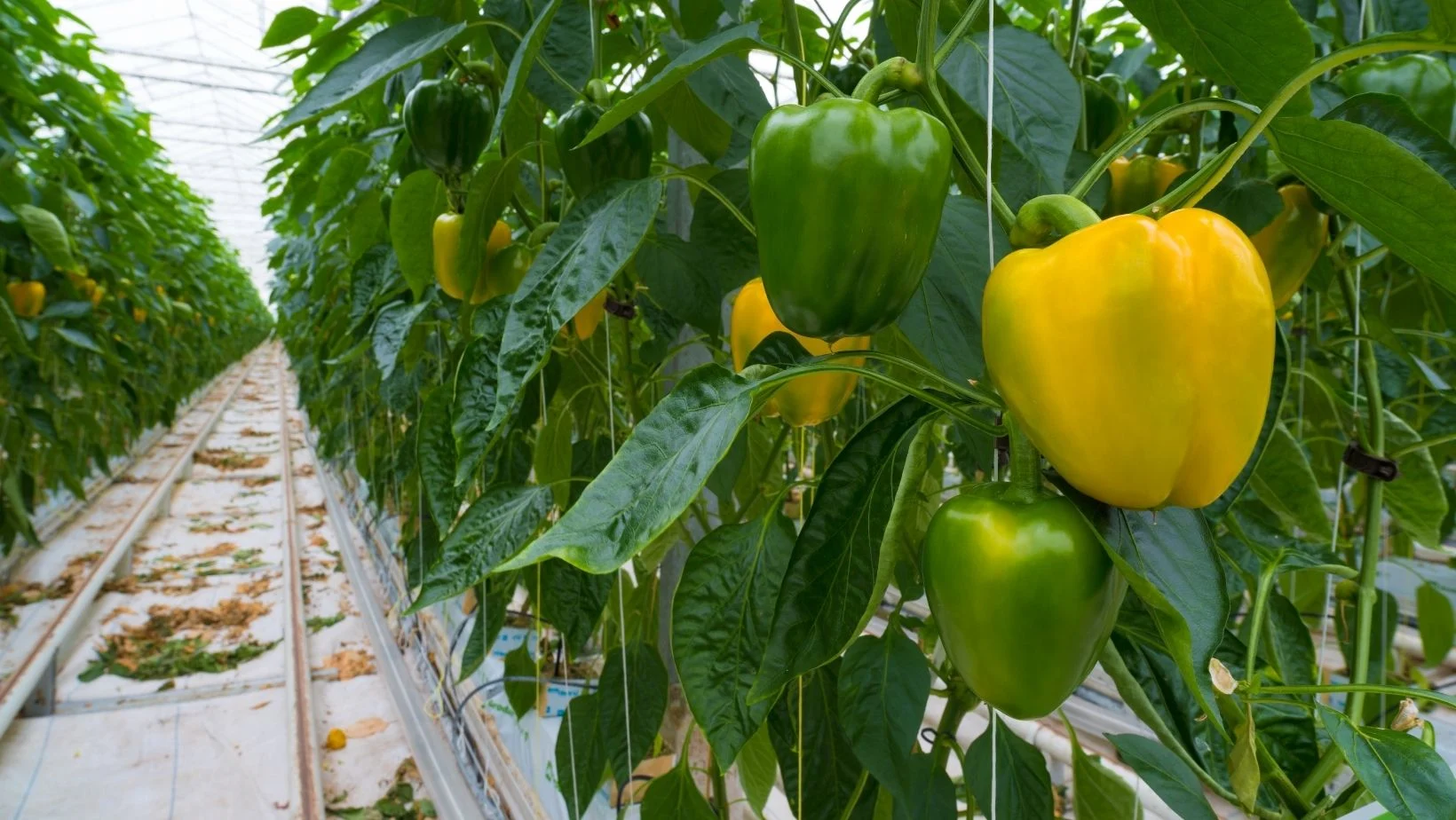
Capsicum farming in Kenya, especially in greenhouses, is profitable, and it can yield double compared to open fields.
However, most farmers have closed down their greenhouses due to losses associated with planting the wrong varieties or poor management.
Greenhouse capsicum farming, either green or colored, holds great potential for giving farmers more money quickly in just 120 days due to the high market demand and good market prices.
This comprehensive article offers a step-by-step guide on how to grow capsicums successfully, from selecting the best variety to fertilization, pest and disease control, cost, and profitability.
In my 8 years of farming, I have seen farmers rise and expand by just specializing in greenhouse capsicum farming simply by doing it right, and therefore I believe you can also do it.
The only thing it requires is patience, and with consecutive harvests, you start making some good profits.
How to Start Greenhouse Capsicum Farming
To start greenhouse capsicum farming, you need a good greenhouse constructed in well-drained, fertile soil with no history of capsicum, tomato, or other crops of similar families to avaoid cases of soil-related pests and diseases, such as nematodes and bacterial wilt.
For beginners, you can construct a simple greenhouse measuring at least 8 m by 5 m. It can either be wooden or metallic.
While constructing, consider the sustainability and flexibility of planting other crops besides capsicums.
The greenhouse should have a good drip irrigation system that offers an even supply of water at all times.
Read Also: How to Grow Capsicums in Kenya: A Complete Guide from Seed to Harvest
The best capsicum varieties for greenhouse farming
Riz F1
The first picking occurs 60-65 days after transplanting.
Has a yield potential of 70-80 tons per acre under optimal conditions.
Individual fruit weight ranges from 220 to 260 grams.
Fruit Characteristics: Produces attractive, compact fruits with thick walls and a vibrant red color.
Disease Resistance to Potato Virus, Tomato Mosaic Virus, Bacterial Wilt, and Peppermint Mild Mottle Virus
Nyuki F1 Yellow
It is one of the best dark yellow blocky hybrids.
Has an early maturity of 50–55 days after transplanting.
Has high vigor and a good canopy.
It is highly tolerant to powdery mildew and bacterial wilt diseases.
Has firm, smooth, and deep yellow fruits at maturity.
Fruits have a thick pericarp, hence good keeping quality.
Each fruit weighs 180–200 g with a yield potential of 30–35 tons per acre.
Commandant F1

A blocky hybrid pepper that eventually turns red at full physiological maturity.
It has red fruit on maturity and a fruit size of 220 g, blocky square, with a yield potential of 25-30 tonnes per acre in an open field and 50-60 tonnes in the greenhouse and a post-harvest shelf life of 21 days.
Kori F1
A very vigorous and cold-tolerant blocky pepper, ideal for greenhouses with spacing of 60 by 45 cm.
Maturity 90 days from transplanting
Fruit weight 220-240 grams
Yield potential of at least 4-5 kg per plant
900 plants per 240 sqm or 450 plants per 120 sqm
Compact leaves and rapid internode growth
Long shelf life
Very good fruit setting
Mature green fruits turn to deep red-colored fruits rapidly.
Plant population: 900/240 sqm, 900/120 sqm
Resistances/Tolerances
- Tobacco Mosaic Virus (L3)
- Tomato Spotted Wilt Virus
Minerva F1
A very vigorous, uniform, and early yellow blocky pepper, ideal for greenhouses with spacing of 60 by 45
Maturity 75 days from transplanting
Fruit weight: 120-150 grams
Yield potential: 10 tonnes per acre
Ideal for both greenhouse and open field.
Deep green-colored fruits
Standard glossy green blocky fruit
Plant population per acre: 19,700
Resistances/Tolerances
Tobacco Mosaic Virus (TM1)
Downy Mildew
Purple Blotch Tolerance
Anthocyanin Tolerance
How to plant capsicums in greenhouses
The soil in the farm should be well ploughed, mixed with manure, and raised into beds. Before transplanting, water first.
Transplant your seedlings on a spacing of 30 cm by 45 cm or 30 cm by 30 cm. Drench immediately with Thunder insecticide to control soil pests such as cutworms.
Avoid over-irrigation to prevent dumping off.
Best Fertiliser for Greenhouse Capsicum Farming
For bigger, well-sized capsicum fruits, top-dress with DAP fertilizers 14 days after transplanting. 30 days after transplanting, top-dress with N.P.K. 17.17.17, and at flowering/fruiting, 45 days after transplanting, top-dress with CAN.
DAP fertilizer enhances root and shoot development, N.P.K 17.17.17 enhances flowering, and CAN helps with fruit expansion.
You can also enhance growth with foliar fertilizers such as Hyrich or Citi Shooter.
Pests and How to Control Them in Greenhouse Capsicum Farming
Whiteflies
Whiteflies are tiny, flying insects that feed on the undersides of leaves. They cause damage by sucking sap from the plants, weakening them and causing yellowing of the leaves. Whiteflies also transmit several plant viruses.
Use yellow sticky traps that attract whiteflies and help monitor and reduce their population. Apply Profile 440EC, DegreeMax, or Oberon speed to control them.
Whiteflies are the most problematic pest as far as greenhouse capsicum farming is concerned.
Leaf miners
Leaf miners are the larvae of certain flies that burrow into capsicum leaves. They create visible trails and tunnels in the leaf tissue, which can lead to a decrease in photosynthesis, weakening the plant and affecting its overall health.
Use Emmaron or Degreemax to control leaf miners in capsicums. Plucking the affected leaves also helps.
Spider Mites
Spider mites are tiny arachnids that feed on capsicum plants by piercing the cells of the leaves and sucking out the sap. This results in stippling, yellowing, and eventual leaf drop. Heavy infestations can weaken the plant and reduce its productivity.
Use Profile or Escort insecticides to control spider mites in capsicums.
Thrips
Thrips are tiny, slender insects that cause significant damage to capsicum crops.
They feed on the leaves, flowers, and fruits of capsicum plants by puncturing the surface and sucking out cell contents. This results in deformed fruits, silvered leaves, and a reduction in overall yield.
Use Profile or Escort insecticides to control thrips in capsicums.
Root-Knot Nematodes
Root-knot nematodes are microscopic roundworms that attack the roots of capsicum plants.
They cause root swelling or galls, impairing the plant’s ability to absorb water and nutrients. This results in stunted growth and reduced yield.
Unfortunately, it doesn’t have a cure and can only be controlled through crop rotation.
Diseases and how to control them in greenhouse capsicum farming
Bacterial Spot
It’s a bacterial disease that shows signs of water-soaked spots on leaves, turning brown and causing defoliation. It is spread through infected seeds and water splashes.
To control bacterial spot in capsicums, apply Pyracopp 400SC or Isaacop.
Powdery Mildew
It’s a fungal infection that shows symptoms of white, powdery patches on leaves and stems. It thrives well in warm and humid conditions.
To control powdery mildew, apply Absolute Star.
Mosaic Virus
It is a viral infection spread by aphids and whiteflies. Crops infested show symptoms of mottled, discoloured patterns on leaves and are spread through contaminated tools, seeds, or insect vectors.
It has no cure.
Anthracnose
It is a fungal infection with symptoms of circular, sunken spots on fruits. It spreads through high humidity and wet conditions.
Phytophthora Blight
It is a soil-borne fungal pathogen with symptoms of wilting, root rot, and water-soaked lesions on stems. It spreads through overwatering and poor drainage.
Cost and profits of greenhouse capsicum farming
Seeds—Ksh 10,000
Fertiliser—Ksh 5,000
Chemicals 7,000
Labour—40,000
Other costs—10,000
Total: 72,000
Estimated yield per greenhouse: 1-2 tons. If a kilo goes for sh 70 per kilo, then the farmer makes sh 140,000. We can conclusively say greenhouse capsicum farming is profitable.
About Post Author




Thanks for sharing kaka.
I’m glad I subscribed.😇
Have a good week.
Amani!👊