

- Before planting, identify the most market-preferred variety
- Kiboko F1, Pretoria F1, Victoria F1, Kilimo F1, and Gloria Star F1 are the best hybrid cabbages to plant in Kenya.
- June and November are the best months to plant cabbage in Kenya.
- Plant at a spacing of 60cm by 50cm
- Apply DAP ,NPK 23.23.0,CAN on 14th,30th and 60th day Respectives
- Control black rot disease, aphids, and DBM pests
REQUIREMENTS FOR CABBAGE FARMING—WHAT YOU NEED
Success in cabbage farming is purely about harvesting big cabbages of the most market-preferred variety at low cost and fetching high prices above KSh. 60 per head.
To get this, you need to: First, identify the market where you will sell your produce, their prices, and the most preferred cabbage variety.
Second, you will need a good-sized farmland with well-drained loam or sandy loam soil. Loam and sandy-loam soils are the best soils for cabbage farming.
Third, you need a reliable permanent water source for irrigation.
For big commercial cabbage farming, drip irrigation is ideal, though costly at the start. Furrow and overhead irrigation are reliable, low-cost methods that do not require significant upfront capital.
Finally, you will need ready capital to cover the cost of seeds, chemicals, fertilizers, and labour.
ALSO READ: Here is the untold truth about how coffee prices are determined prior to sale
BEST CABBAGE VARIETIES TO PLANT IN KENYA—HYBRID AND OPV
When it comes to cabbage farming, different varieties perform differently. While open-pollinated varieties like Copenhagen Cabbage are cheap compared to hybrids, their yields are low.
Kiboko F1, Pretoria F1, Victoria F1, Kilimo F1, and Gloria Star F1 are the best hybrid cabbages to plant in Kenya.
Kiboko F1 is a hybrid cabbage that is a compact round-head variety with bluish waxy leaves and matures in 80–90 days, weighing 6–8 kg.

With a spacing of 60 cm by 45 cm, an acre can hold 11,250 cabbages and produce a total yield of 45–69 tons.
Pretoria F1 is the best heat-tolerant cabbage variety in Kenya. It is the variety to choose if your farm is located in dry areas.
It is dark green in colour and matures in 75 days after transplanting, with a head weight of 5–6 kg.
Victoria F1 is loved for its high uniformity of heads and early maturity of 70–75 days, with a compact head of 4–5 kg.
Kilimo F1 is a medium-headed cabbage variety with a maturity of 70–85 days. It has good resistance to Black Rot.
BEST MONTH TO PLANT CABBAGES
Normally, plant cabbage in a way that harvesting coincides with dry months when there is a high shortage.
June and November are the best months to plant cabbages in Kenya.
However, with changing weather patterns, there are months when there is high rainfall that destroys most farmlands and makes roads to farms inaccessible, creating an artificial shortage that pushes prices to the roof.
Though these are rare scenarios in cabbage farming, when they happen, farming becomes very profitable.
HOW TO RAISE CABBAGE SEEDLINGS
Farmers have two options when it comes to raising seedlings for cabbage farming: outsourcing or raising their own.
Seedlings often cost KSh. 3–4 each. This is expensive compared to raising your own. An acre requires 60–100 g of seed.
Make a raised seedbed with loose soil and sow seeds sparingly. Water often. You can make a shade to avoid direct sunlight and rain.
Cabbage seeds take 4–7 days to germinate and 4 weeks to develop 4–5 leaves ready for transplanting. Withdraw irrigation 3 days before transplanting to harden the seedlings.
It is recommended to apply Redomill Gold (fungicide) on the eve of transplanting to prevent damping off.
HOW TO PLANT CABBAGES
Make holes with a spacing of 60 cm by 45 cm. Each hole should be large enough to hold 2 kg of well-decomposed manure.
This is a must if you want healthy cabbage that will grow fast.
Transplant the 4–5 leaved seedling in the middle of the hole and water.
Drench with Thunder OD 145 and Aquawet solution. This is to eliminate cutworms and enhance new root growth.
BEST FERTILIZERS FOR CABBAGE FARMING
Do not plant cabbage with DAP fertilizer. Instead, top-dress it 14 days after transplanting.
One month after transplanting, top-dress with NPK 23.23.0.
This has high nitrogen for boosting shoot growth and high phosphorus for deep root development.
Apply CAN two months after transplanting.
DISCLAIMER:
Apply fertilisers only on wet soil or water after application.
Fertilisers should be applied at the base and should not come into contact with the leaves or the stem, as it can cause scorching.
In cabbage farming, avoid applying high-nitrogen fertilisers like DAP, UREA, or NPK 23.23.0 in the last month before harvest, as they can slow the folding process and reduce compactness.
You can apply Maxigrow Vegetative in the first month and Maxigrow Zinc & Boron at the end of the second month to enhance compactness.
CABBAGE FARMING: COMMON DISEASES
Black Rot: It is a bacterial disease with the characteristic symptom of a V-shaped lesion extending inward from the leaf edge.
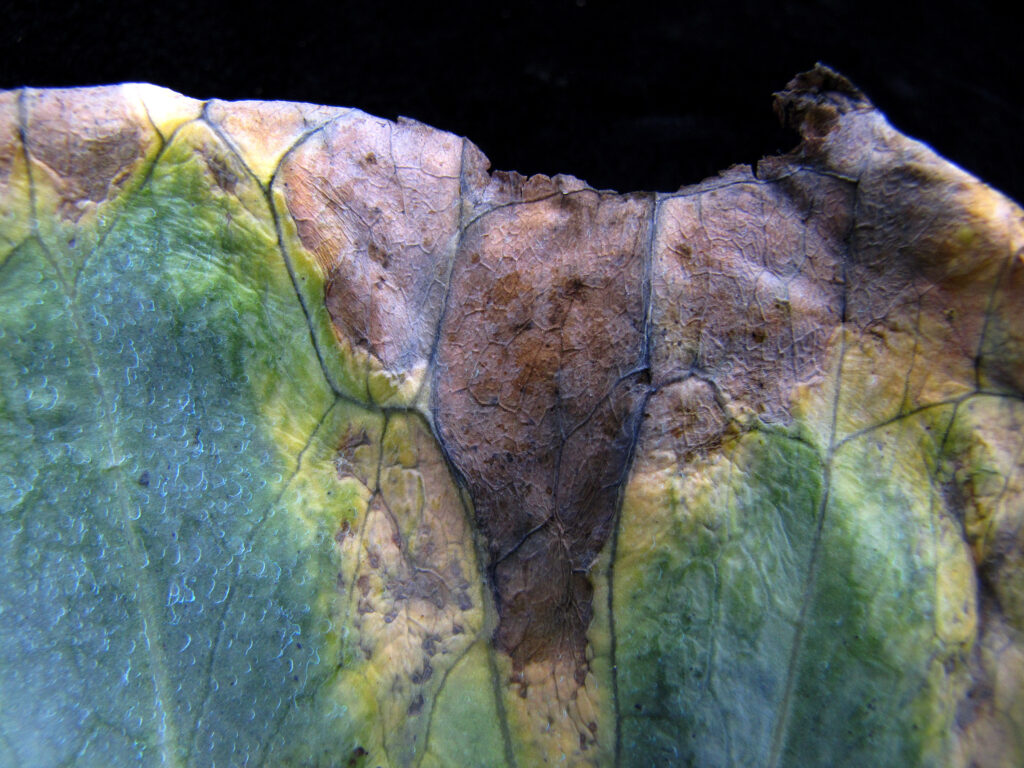
Initially, it is dull yellow, then the centre turns brown and becomes desiccated.
Symptoms appear about 10–14 days after infection; the timeframe may be longer under suboptimal temperatures.
As the disease progresses, most of the leaf blade can become affected.
It is transmitted through planting affected seeds or seedlings. Black rot can be carried from an affected farm through farm workers and equipment.
To be safe, plant varieties known to be resistant to Black Rot. Treating seed with hot water can be effective for killing bacteria on and inside the seed when the seed lot is not heavily contaminated.
Applying copper fungicides can be used for controlling Black Rot.
However, it is good to note that some bacterial pathogens, including the one causing Black Rot, can develop copper resistance.
Clean all equipment after use in an affected crop. When using overhead irrigation, do it when the crop is dry—during the day.
If done when dew is present, it is the worst time, as bacteria can be in guttation water that exudes from hydathodes along leaf margins.
Immediately after harvest, destroy crop debris such as by flail chopping, and then incorporate it into the soil.
COMMON CABBAGE PESTS
Aphids: They are grey-green but usually appear grey or white due to a dusty, waxy secretion that covers their bodies.
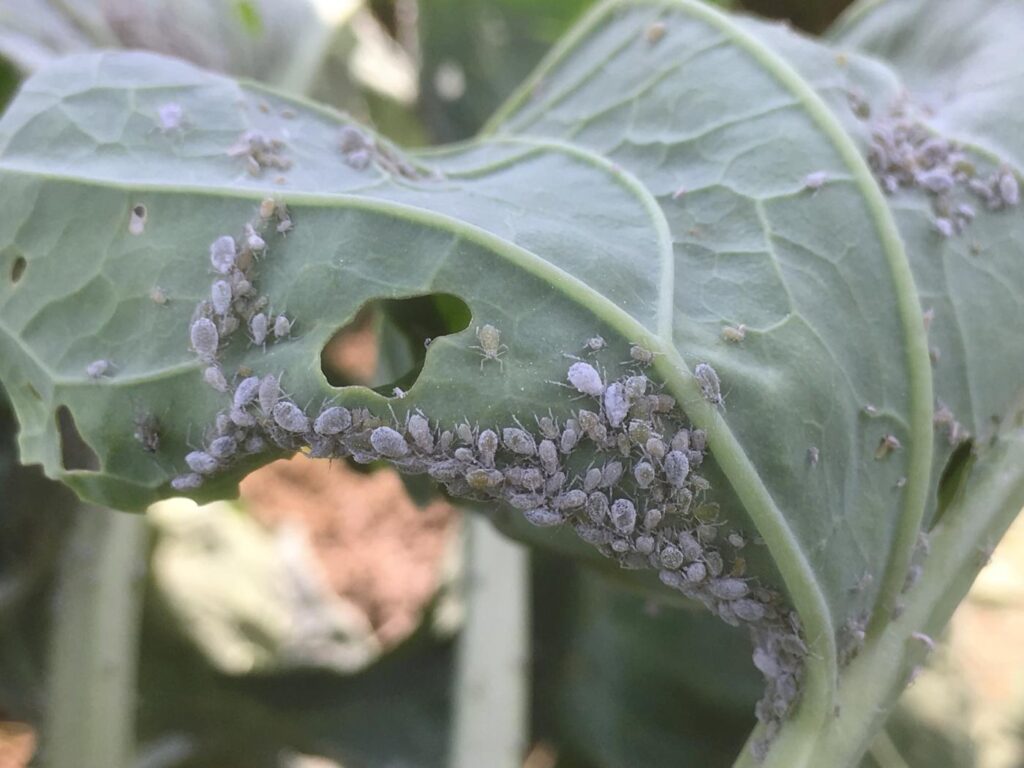
They prefer to feed on young leaves with injuries, including wrinkled and downward-curling leaves, yellow leaves, and reduced growth.
Apply Emerald 200SL to control Aphids.
Diamond Back Moth (DBM): These are the most destructive pests in cabbage farming.
They chew holes known as “windows” when they feed on the underside of leaves.
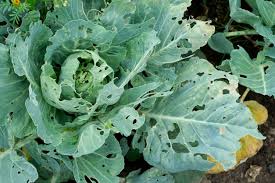
Apply Amigad 5.7 WDG or Escort 19EC or Emmaron 30SC to control Diamond Back Moth.