 Kelvin Wairimu
Before you plant that first avocado seedling, ask yourself: Do you have Ksh 400,000 and three years to wait for returns?
This comprehensive business plan provides Kenyan farmers with critical data-driven insights for making informed investment decisions in avocado farming.
We analyze real costs, profit margins, and export requirements to determine if avocado farming delivers the promised returns.
Understanding Kenya’s Avocado Export Reality
Kenya earned Ksh 14.48 billion from avocado exports in 2024, positioning the country as Africa’s leading avocado exporter.
However, this success story masks sisignificant challenges that many farmers overlook.
Production declined by 11.2% in 2024 due to climate variability, while only 30% of farmers achieve profitable export-grade quality standards.
The current “avocado rush” has led to oversupply in some regions.
Poor planning has resulted in many farmers failing to break even. This guide provides the missing framework for sustainable, profitable avocado enterprises.
Strategic Variety Selection for Maximum Returns
Hass Variety: The Export Champion
Hass avocados dominate 85% of Kenya’s export market. They command premium prices of Ksh 60-120 per kilogram for export-grade fruit. The variety’s dark, pebbly skin and creamy texture meet European Union standards perfectly.
Fuerte Variety: The Local Market Alternative
Fuerte avocados serve domestic markets effectively.
They produce fruit year-round but fetch lower prices of Ksh 30-50 per kilogram.
Consider Fuerte only for mixed farming systems or local market focus.
Grafted vs. Seedling Trees
Invest exclusively in grafted seedlings. They begin production in 3-4 years versus 5-7 years for seedlings.
Grafted trees produce uniform, export-quality fruit with predictable yields of 50-100kg annually.
Prime Location Analysis for Optimal Production
Altitude Requirements
Plant avocados between 1,200-2,100 meters above sea level. This altitude range provides optimal temperature conditions of 20-28°C.
Higher altitudes delay maturity while lower altitudes reduce fruit quality.

Regional Performance Data
– Murang’a County: Produces 31% of national output with yields averaging 80kg per tree
– Kiambu County: Achieves premium export grades with proper management
– Meru County: Emerging region with excellent climatic conditions
– Nyeri County: High-quality production but transport costs affect profitability
Rainfall Patterns
Target areas receiving 1,000-1,500 mm annual rainfall. Ensure consistent water availability during dry seasons through irrigation systems. Inconsistent water supply reduces fruit size and export quality.
Read Also: Is Hass avocado farming profitable? Cost and Profit Analysis
Critical Soil Requirements and Preparation
Soil Testing Essentials
Conduct comprehensive soil analysis before planting. Optimal parameters include pH 6.0-7.0, good drainage, and organic matter content above 3%. Poor soil preparation causes 40% of avocado farming failures in Kenya.
Drainage Solutions
Install proper drainage systems on all slopes.
Waterlogged soil causes root rot, the leading cause of tree mortality.
Raised beds improve drainage in heavy clay soils common in Central Kenya.
Organic Matter Management
Apply 20-30 tons of well-decomposed manure per acre annually.
Incorporate cover crops like desmodium to improve soil structure.
Healthy soils reduce fertilizer costs by 30% while improving fruit quality.
Integrated Pest and Disease Management Strategy
Major Disease Threats
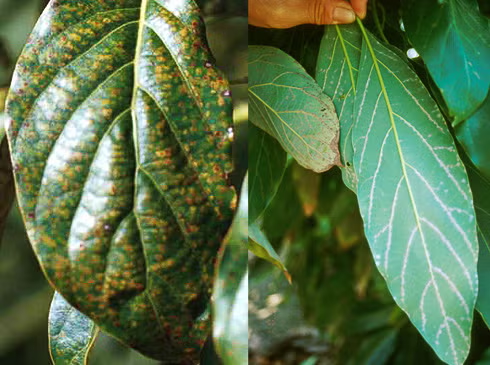
Root rot (Phytophthora) affects 25% of Kenyan avocado farms. Apply copper-based fungicides preventively and improve drainage.
Anthracnose damages fruit quality; spray with appropriate fungicides during flowering.
Key Pest Management
Thrips cause fruit scarring, reducing export grades. Use integrated pest management combining beneficial insects with selective spraying. False codling moth requires regular monitoring and targeted interventions.
Certification Requirements
Implement Global GAP standards from establishment.
Document all pesticide applications with proper withdrawal periods.
Residue testing failures cost farmers entire shipments worth millions of shillings.
Precision Harvesting for Export Quality
Maturity Indicators
Harvest Hass avocados when skin begins darkening but before full black coloration.
Use dry matter content testing (21-25%) for accurate timing.
Premature harvesting reduces fruit size and market value.
Handling Protocols
Maintain cold chain from harvest to export.
Fruit temperature must not exceed 7°C during transport.
Proper handling reduces post-harvest losses from current 30% to below 10%.
Quality Grading Standards
Export markets demand specific size ranges: Small (100-180g), Medium (180-300g), Large (300g+).
Maintain consistent quality through proper nutrition and water management throughout the season.
Export Market Requirements and Compliance
Certification Framework
Obtain multiple certifications:
GlobalGAP for food safety, organic certification for premium markets, and carbon footprint certification for sustainability-conscious buyers.
Certification costs Ksh 150,000-300,000 but increases prices by 20-40%.
Market Access Channels
The European Union remains the primary market, absorbing 70% of Kenyan exports.
Middle Eastern markets offer growing opportunities with fewer stringent requirements. Diversify market access through cooperative membership.
Documentation Requirements
Maintain detailed records for traceability.
Export documentations include phytosanitary certificates, certificates of origin, and quality inspection reports.
Poor documentation causes shipment delays and market access problems.
Comprehensive Cost and Profit Analysis
Initial Investment Breakdown (Per Acre)
- Land preparation and planting: Ksh 50,000
– Grafted seedlings (150 trees): Ksh 45,000
- Irrigation system installation: Ksh 180,000
- Fencing and infrastructure: Ksh 80,000
Total Year 1 Investment: Ksh 355,000
Annual Operating Costs (Years 2-4)
– Fertilizers and soil amendments: Ksh 60,000
– Pest and disease management: Ksh 35,000
– Labor (pruning, weeding, harvesting): Ksh 120,000
– Water and utilities: Ksh 25,000
Annual Operating Costs: Ksh 240,000
Revenue Projections (Mature Trees – Year 5+)
– Average yield per tree: 75kg
– Trees per acre: 150
– Export price per kg: Ksh 50
– Gross Revenue: Ksh 562,000
Net Profit: Ksh 322,000 annually (initial cost not included)
Return on Investment Analysis
Break-even occurs in Year 6 with proper management. Total investment recovery happens by Year 7. Mature orchards generate 65% profit margins with consistent export market access.
Risk Assessment and Mitigation Strategies
Climate Change Impacts
Irregular rainfall patterns affect 60% of avocado farms annually.
Install drip irrigation systems and rainwater harvesting to mitigate weather risks. Climate-smart varieties show better resilience.
Market Price Volatility
Export prices fluctuate between Ksh 50-120 per kilogram based on global supply.
Diversify income through value addition (avocado oil, processed products) and local market sales during price dips.
Production Challenges
Poor extension services result in suboptimal yields for 70% of smallholder farmers.
Invest in technical training and join farmer cooperatives for shared knowledge and resources.
Financial Viability Assessment: The Bottom Line
Avocado farming presents a viable business opportunity for well-prepared farmers with adequate capital and patience.
Success requires:
Minimum Capital Requirements: Ksh 500,000 for a sustainable one-acre establishment
Timeline to Profitability: 5-6 years from planting
Annual Profit Potential: Ksh 300,000-600,000 per acre (mature orchards) depending on prevailing market prices.
Success Rate: 30% of farmers achieved projected returns due to poor planning
The business works for farmers who:
– Possess adequate startup capital without borrowing
– Can wait 5+ years for significant returns
– Commit to proper technical management
- Have reliable water access
– Plan for export market compliance from day one
Recommendation: Proceed with avocado farming only if you meet ALL the above criteria. The “get-rich-quick” narrative is misleading.
Successful avocado farming requires substantial investment, patience, and professional management.
Ready to develop your professional avocado farming business plan?
Contact FarmWorx Kenya for comprehensive feasibility studies, technical guidance, and market access support.
Our experienced team helps you avoid costly mistakes while maximizing your investment potential.
Call FarmWorx Kenya: +254-736 906 427 | Email: info@farmworxkenya.co.ke
About Post Author